
Summary
Introduction
The advent of the "universal wing" has made possible three alternative loadings to a Spitfire. When such a wing is fitted the Mark number of the aeroplane is followed by the suffix "c" and the aeroplane can be flown with 8- .303" guns, 2 - 20 m/m guns plus 4 - .303" guns, or 4 - 20 m/m guns. Of the three loadings, the first two have been tested and used in previous Spitfires, but the Spitfire at the third loading has not previously been tested for performance and general handling at the A. & A.E.E., and for this reason, brief tests were called for. This report deals with the results of those tests.
Condition of aircraft relevant to tests
Throughout the trials the aircraft was loaded to an all-up weight of 6,917 lb. with the centre of gravity 7.4" aft of the datum point. The design centre of gravity limits are from 5.0" to 7.7" aft of the datum or from 5.0" to 8.2" aft of the datum including the aft extension.
The aeroplane was fitted with universal wings, 4 - 20 m/m guns and an internal bullet-proof windscreen.
No snow-guard was fitted during the tests.
A rear view mirror was mounted on top of the pilots hood outside, and triple-ejector exhausts were fitted (without fishtails).
I.F.F. aerials, a W/T mast, and aerial were installed.
The aeroplane was fitted with a 7 1/2 lb. inertia weight in the elevator control circuit.
Results of tests
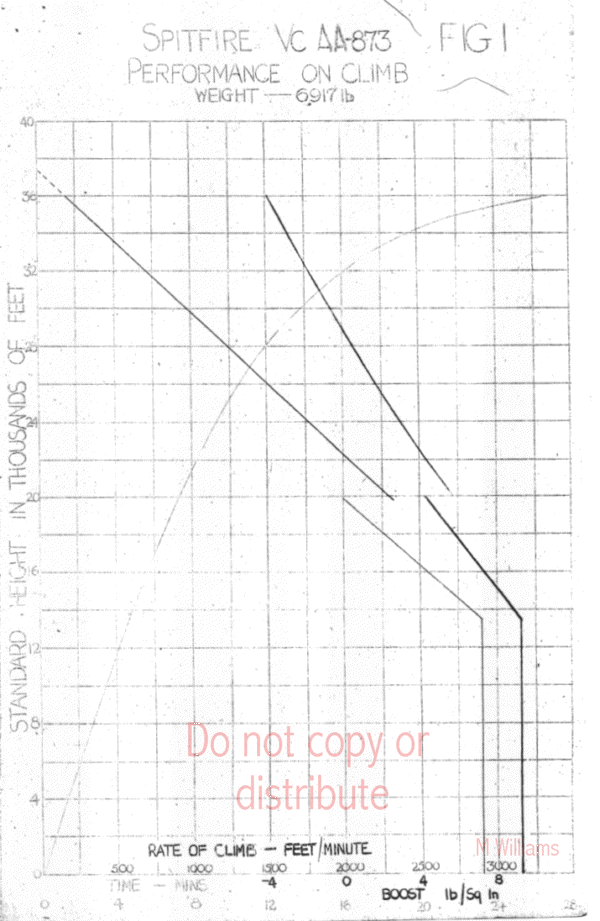
(i) The maximum rate of climb is 2,900 feet/minute at 13,400 feet. The time to 20,000 feet is 7.4 minutes, and the estimated service ceiling is 36,400 feet. The results are given in Table I and Fig.1.
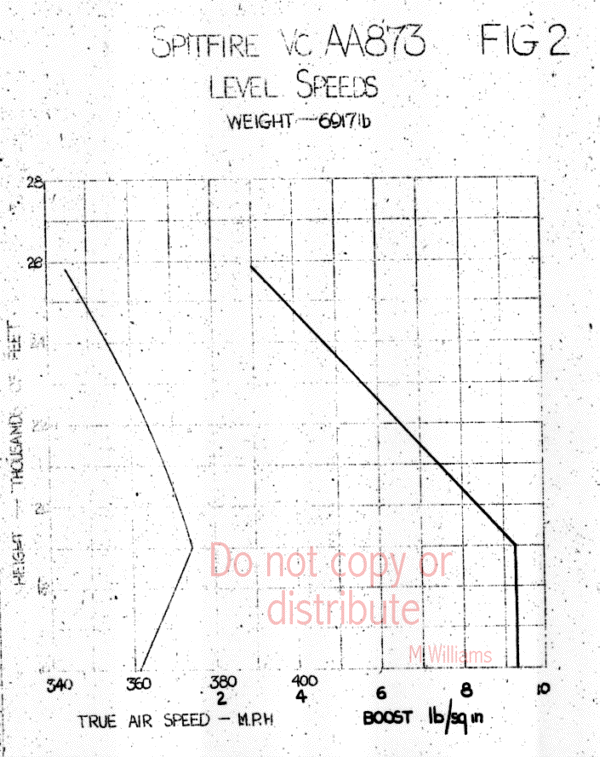
(ii) The top speed is 374 m.p.h. at 19,000 feet.
The results of the speed trials are given in Table II and Fig.2.
(iii) There is no noticeable difference between the handling characteristics of this aeroplane and other Spitfire V types.
Handling
Stall
Flaps and undercarriage UP
At about 90 m.p.h. A.S.I. a considerable amount of buffeting around the hood commences. The A.S.I. can be reduced to 81 m.p.h. but at this speed sharp fore and aft pitching occurs together with increase of buffeting. This sharp fore and aft pitch prevents the control column from being held fully aft.
In general the stall of the aeroplane is not clearly defined.
There were no signs of either wing tending to drop. The elevator is moderately heavy though effectiveness has fallen off considerably.
Flaps DOWN
The stalling speed of the aeroplane with flaps down is 71 m.p.h. A.S.I.
There is a considerable amount of buffeting
around the hood at the stall, together with a slight lateral oscillation.
Flaps and undercarriage DOWN
The characteristics are the same as for the case with flaps down and undercarriage up. The control column can be brought almost fully aft, but use of ailerons and rudder are necessary in order to maintain an even keel. With the control column in the fully aft position either wing tends to drop.
Tests done on Spitfire K.9787 at a weight of 5,819 lb. gave the stalling speeds as 64 m.p.h. A.S.I. with flaps and undercarriage up, and 58 m.p.h. with flaps and undercarriage down.
Corrected to the weight of Vc AA.873, these speeds become :
which are 8 m.p.h. lower than the stalling speeds of AA.873. This difference must be due to the combined effect of the differences between the aeroplanes which comprises the leading edge proturberances of the 20 m/m guns, the pilots rear view mirror which was not previously fitted, and the constant speed 3-blade metal propeller which has replaced the fixed pitch 2-blade wooden propeller.
Dive
The diving limitations with the throttle at least 1/3 open are 465 m.p.h. A.S.I. and 3,600 R.P.M.
In the dive the aeroplane became noticeable tail-heavy at airspeeds in excess of 360 m.p.h. A.S.I. The force required to hold the aeroplane in the dive waas slightly more than usual for the type. Whilst this tendency to tail heaviness is general for the type, difficulty over longitudinal trim was experienced on this aeroplane, and it is attibuted to the fact that the trimming tab fitted badly and could be easily distorted with the fingers on the ground.
Experience gained on another aircraft leads to the conclusion that a trimming tab which can be easily distorted on the ground will distort in the air at high speed. Thus, with the aeroplane trimmed for "all-out" level flight, the stick force in the dive might increase if the trimmer were blown back by the air force.
At speeds up to 450 m.p.h. A.S.I. the aeroplane behave normally in all other respects.
Landing
This is quite normal and satisfactory. The gliding speed on the approach is approximately 90 m.p.h. A.S.I.
TABLE I
CLIMBING TRIALS
| Height in standard atmosphere (feet) |
Time from start (min) |
Rate of Climb (ft/min) |
True air Speed (mph) |
A.S.I. (mph) |
P.E.C. | C.E.C. | R.P.M. | Boost (lb/sq.in.) |
Mixture |
|---|---|---|---|---|---|---|---|---|---|
| Sea level | 0 | - | - | - | - | - | - | 9.3 | Rich |
| 1,000 | .35 | 2900 | 168.5 | 167.5 | -1.7 | - | 2850 | 9.3 | " |
| 2,000 | .7 | 2900 | 171 | 167.5 | -1.7 | - | " | 9.3 | " |
| 3,000 | 1.0 | 2900 | 173 | 167.5 | -1.7 | -.1 | " | 9.3 | " |
| 5,000 | 1.4 | 2900 | 178.5 | 167.5 | -1.7 | -.2 | " | 9.3 | " |
| 6,500 | 2.25 | 2900 | 182 | 167.5 | -1.7 | -.3 | " | 9.3 | " |
| 10,000 | 3.5 | 2900 | 183.0 | 158 | -0.2 | -.3 | " | 9.3 | " |
| 13,000 | 4.5 | 2900 | 187.5 | 153.5 | +0.5 | -.5 | " | 9.3 | " |
| *13,400 | 4.6 | 2900 | 188.0 | 153 | +0.6 | -.5 | " | 9.3 | " |
| 15,000 | 5.2 | 2690 | 191.0 | 151 | +1.0 | -.5 | " | 8.0 | " |
| 16,500 | 5.8 | 2475 | 194.5 | 150.0 | +1.2 | -.6 | " | 6.9 | " |
| 18,000 | 6.4 | 2250 | 197.0 | 148 | +1.5 | -.7 | " | 5.8 | " |
| 20,000 | 7.35 | 2300 | 201.5 | 146 | +1.9 | -.8 | 3000 | 5.8 | " |
| 23,000 | 8.8 | 1910 | 205 | 140 | +3.0 | -.8 | " | 3.6 | " |
| 26,000 | 10.55 | 1520 | 208.5 | 134 | +4.0 | -.9 | " | 1.6 | " |
| 28,000 | 12.0 | 1240 | 211 | 130 | +4.9 | -1.0 | " | 0.4 | " |
| 30,000 | 13.8 | 980 | 214.5 | 126 | +5.7 | -1.0 | " | -0.6 | " |
| 32,000 | 16.2 | 720 | 216.5 | 122 | +6.5 | -1.0 | " | -1.8 | " |
| 34,000 | 19.7 | 440 | 219.5 | 118 | +7.3 | -1.0 | " | -2.8 | " |
| 36,000 | 27.3 | 180 | 220.5 | 113 | +8.3 | -1.0 | " | -4.0 | " |
| Estimated absolute ceiling | 37,400 feet | Greatest height reached: | 36,000 ft. | ||||||
| R.P.M. stationary on ground: | 2,520 | Boost pressure lb/sq.in.: | +9.3 | ||||||
| * Full throttle height | |||||||||
| Service ceiling | 36,400 ft. (estimated) | ||||||||
TABLE II
SPEED TRIALS
| Height in standard atmosphere (feet) |
True air Speed (mph) |
A.S.I. (mph) |
P.E.C. | C.E.C. | R.P.M. | Boost (lb/sq.in.) |
|---|---|---|---|---|---|---|
| 16,500 | 363 | 294 | -8.5 | -4.4 | 3000 | 9.3 |
| 18,000 | 370 | 292.5 | -8.5 | -4.9 | " | 9.3 |
| 19,000* | 374 | 291.5 | -8.5 | -5.1 | " | 9.3 |
| 20,000 | 371.5 | 284 | -8.5 | -4.6 | " | 8.35 |
| 23,000 | 359.5 | 263 | -8.5 | -5.1 | " | 5.6 |
| 25,000 | 349 | 247 | -8.2 | -5.0 | " | 3.7 |
| * Full throttle height | ||||||